
Why Businesses Need to Compare Energy Suppliers
Commercial Electricity Supply: Why Businesses Need to Compare Energy Suppliers and Save Money
For most businesses, electricity and natural gas are necessary operating expenses. Whether you operate a manufacturing facility, office building, restaurant, retail store, warehouse, apartment complex, or other commercial property, energy costs can represent a significant portion of your monthly overhead.
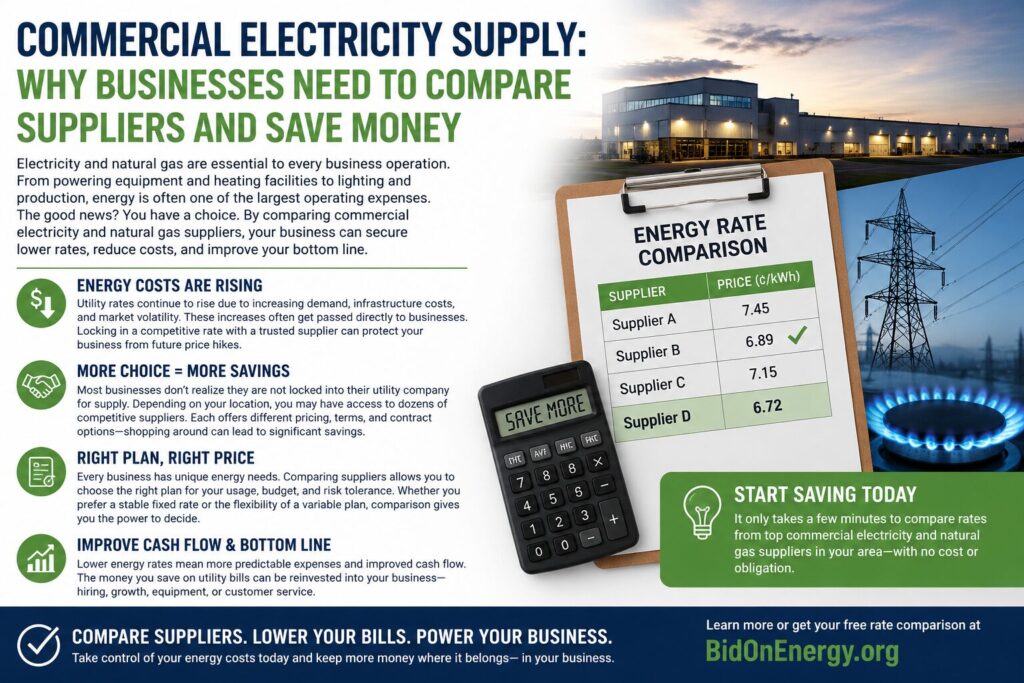
The good news is that businesses in competitive energy markets may have a choice when it comes to who supplies their electricity and natural gas. Comparing commercial energy suppliers can help businesses find lower rates, control costs, and reduce monthly utility bills.
Why Compare Commercial Electricity Suppliers?
Your local utility is responsible for delivering electricity to your business, maintaining the distribution system, and responding to outages. However, in many deregulated energy markets, businesses can choose a competitive supplier for the electricity supply portion of their bill.
Different suppliers may offer different rates, contract lengths, products, and pricing structures. Instead of automatically accepting your utility's supply rate or renewing with your existing supplier, it makes sense to compare your options.
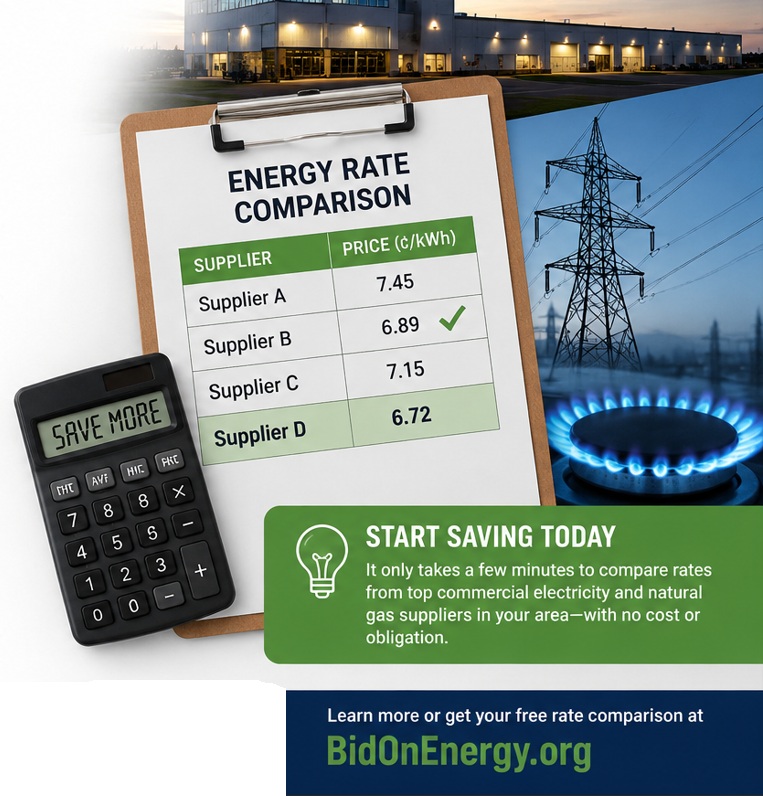
Even a relatively small difference in the price per kilowatt-hour can result in substantial savings for a business that consumes large amounts of electricity.
For example, a company using 1,000,000 kWh annually could potentially save:
- 0.5¢/kWh lower rate = $5,000 per year
- 1.0¢/kWh lower rate = $10,000 per year
- 2.0¢/kWh lower rate = $20,000 per year
The greater your energy consumption, the more important competitive pricing becomes.
Commercial Natural Gas Rates Should Be Compared Too
Electricity isn't the only energy expense businesses should review.
Companies using natural gas for heating, manufacturing, cooking, hot water, processing, or other operations may also be able to choose among competitive natural gas suppliers.
Natural gas prices can fluctuate considerably depending on market conditions, weather, supply and demand, transportation costs, storage levels, and contract timing.
Comparing natural gas suppliers allows businesses to evaluate available rates and contract options before making a purchasing decision.
Don't Automatically Renew Your Existing Energy Contract
One of the biggest mistakes a business can make is simply renewing an existing electricity or natural gas agreement without checking the market.
The supplier that offered a competitive rate two or three years ago may not have the best price today.
Before your current contract expires, compare multiple suppliers and contract terms. Starting the process early gives your business more time to evaluate the market instead of being forced into a last-minute decision.
Lower Energy Rates Can Improve Your Bottom Line
Reducing energy expenses is different from many other cost-cutting measures because it doesn't necessarily require reducing employees, services, production, or operating hours.
If your business consumes the same amount of electricity but purchases that electricity at a lower rate, the savings go directly toward reducing operating expenses.
Money saved on utility bills can instead be used for:
Hiring employees, purchasing equipment, expanding operations, marketing, technology upgrades, inventory, building improvements, or increasing profitability.
For energy-intensive businesses, controlling electricity and natural gas costs can have a meaningful impact on overall profitability.
Every Business Has Different Energy Needs
There isn't one electricity or natural gas plan that's right for every company.
Manufacturing companies, restaurants, warehouses, commercial buildings, retail stores, hotels, healthcare facilities, and offices all have different consumption patterns.
That's why businesses should compare more than just the advertised price.
Important considerations can include the supply rate, contract term, fixed versus variable pricing, start date, expiration date, early termination provisions, capacity and transmission charges, and other pass-through or adjustment provisions.
Understanding what is included in the quoted price is especially important when comparing commercial electricity offers.
Fixed Rates Can Help Businesses Budget
Many businesses prefer fixed-rate electricity or natural gas agreements because they provide greater price certainty.
A competitive fixed rate can help protect a business from unexpected changes in wholesale energy markets and make budgeting future energy expenses easier.
However, the lowest advertised rate isn't automatically the best contract. Businesses should understand exactly which components are fixed and which charges can change during the agreement.
Compare Before You Sign
Energy markets change constantly. Supplier pricing available today can be different next week, next month, or next year.
Businesses should make energy comparison part of their normal purchasing process.
Before signing a new electricity or natural gas contract:
Compare multiple suppliers. Compare several contract terms. Understand what is included in the rate. Review your current contract expiration date. Calculate the potential annual cost not simply the rate.
The objective is simple: find the combination of competitive pricing, contract protection, and terms that makes the most financial sense for your business.
Start Saving on Commercial Electricity and Natural Gas
Your business already pays for electricity and natural gas. The question is whether you're paying more than necessary.
Taking a few minutes to compare commercial electricity and natural gas suppliers could potentially save your company thousands of dollars over the life of an energy contract.
Compare suppliers. Lower your energy costs. Reduce your utility bills. Keep more money in your business.
Visit BidOnEnergy.org to compare commercial electricity and natural gas supplier rates and explore available energy options for your business.