
September 2026 Commercial Energy Outlook
September 2026 Commercial Energy Outlook
Electricity & Natural Gas Market Analysis for U.S. Businesses
Commercial Energy Outlook · September 2026
September marks an important transition for commercial energy buyers. Peak summer electricity demand is beginning to fade, natural gas inventories are relatively strong, and businesses are entering the fall “shoulder season” ahead of winter.
The overall market picture entering September is more favorable than it was during the summer, particularly for natural gas. However, commercial electricity buyers should not assume that lower natural gas prices automatically mean lower electric bills. Capacity, transmission, utility delivery charges and continued growth in electricity demand remain significant cost pressures.
For businesses with electricity or natural gas contracts expiring during the next 3 to 12 months, September is a good time to compare suppliers and begin evaluating fixed-rate options.
September 2026 Energy Market Snapshot
| Market Indicator | September 2026 Outlook |
|---|---|
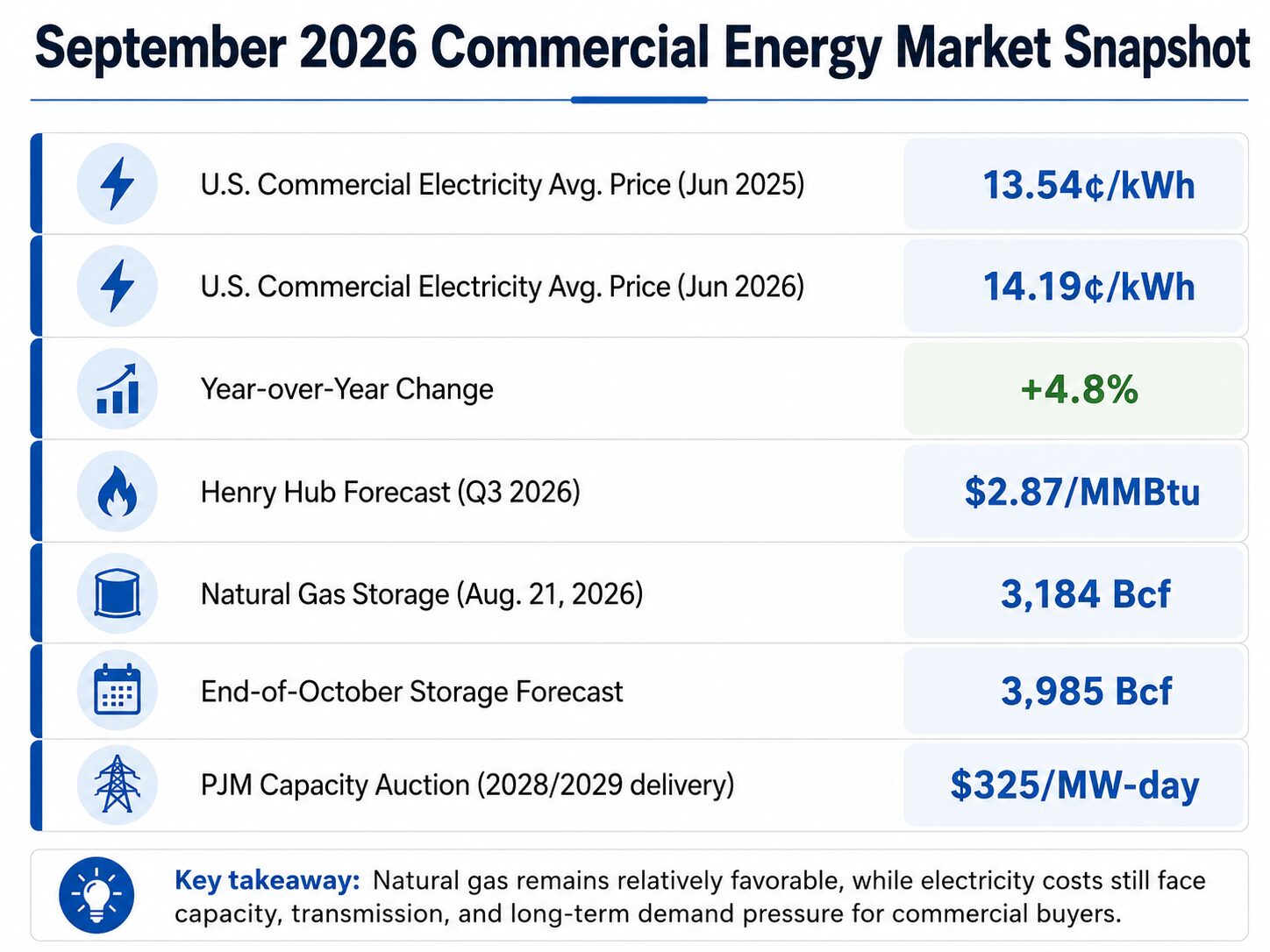
| U.S. Commercial Electricity | 14.19¢/kWh latest national average |
| Commercial Rate Trend | +4.8% year over year |
| Henry Hub Natural Gas | $2.87/MMBtu Q3 forecast |
| Natural Gas Storage | 3.184 Tcf as of Aug. 21 |
| Winter Gas Storage Outlook | Approximately 3.985 Tcf by end of October |
| PJM Capacity Market | Capacity costs remain historically elevated |
| Electricity Demand | Continued growth, particularly from commercial and large-load customers |
| September Buyer Outlook | Favorable time to compare forward fixed rates |
The latest EIA data show that the average U.S. commercial electricity price was 14.19¢/kWh in June 2026, compared with 13.54¢/kWh one year earlier—a 4.8% increase. Commercial electricity sales were also 3.4% higher year over year.
Remember that the national commercial average represents the total retail electricity price, not simply the competitive supplier portion of a business's utility bill. Actual supply rates vary considerably by utility, state, rate class, usage, load factor and contract structure.
Electricity Outlook: Summer Pressure Is Easing, but Long-Term Costs Remain a Concern
September normally brings declining air-conditioning demand across much of the country. This can reduce some of the extreme spot-market pressure seen during July and August.
But 2026 demonstrated how quickly electricity demand continues to grow.
ERCOT, for example, recorded several extremely high demand levels this summer. Demand reached approximately 91,134 MW on July 22, while August also produced multiple days near or above 90,000 MW.
Increasing electricity requirements from data centers, manufacturing, electrification and general economic growth are becoming increasingly important parts of the forward electricity market. The EIA reports that growing data-center demand continues to influence U.S. electricity forecasts. Solar generation and natural gas generation are providing much of the additional supply needed to meet that growth.
For commercial customers, this means the end of summer does not necessarily signal the end of upward electricity cost pressure.
PJM Capacity Costs Remain One of the Biggest Issues
Businesses located in PJM—including large portions of Pennsylvania, New Jersey, Maryland, Delaware, Ohio, Illinois and the Mid-Atlantic—should pay particularly close attention to capacity.
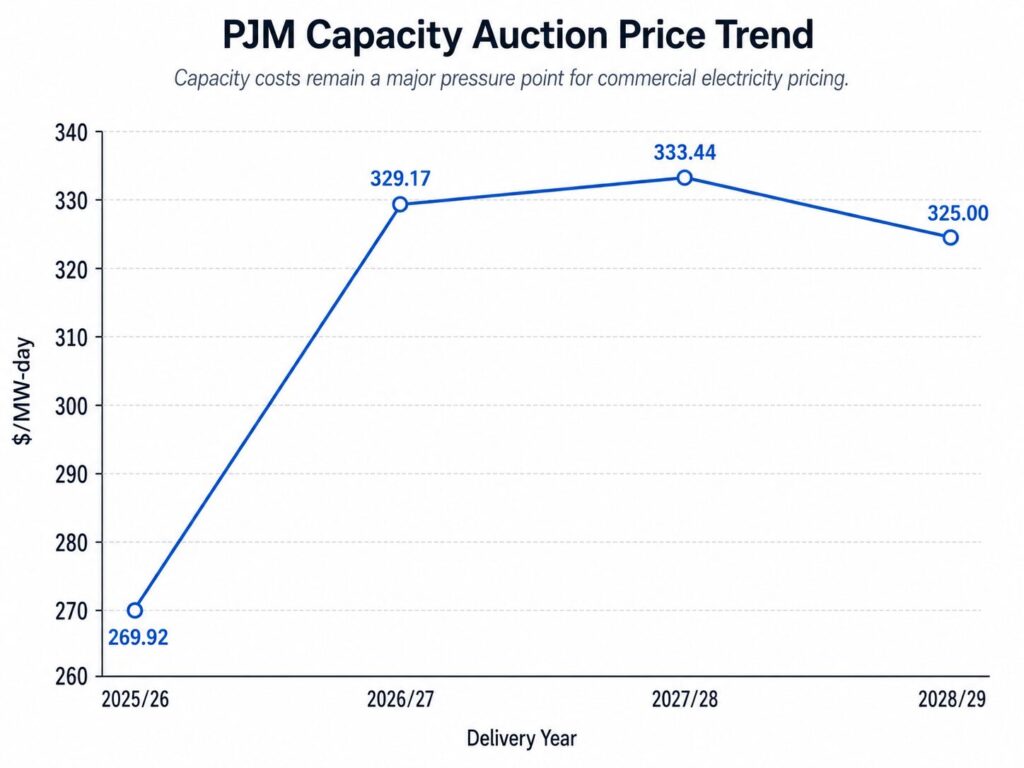
PJM's 2027/2028 capacity auction cleared at approximately $333.44/MW-day, essentially at the approved price cap. PJM also reported that capacity secured in the auction fell approximately 6,623 MW short of its reliability requirement.
This follows the dramatic increase in capacity costs that began with earlier PJM auctions.
The implication for commercial customers is important:
The energy commodity itself may decline while the total electricity price remains elevated because capacity, transmission and other non-energy components increase.
This is why comparing contracts based solely on the advertised cents-per-kWh energy price can be misleading.
Natural Gas Outlook: September 2026 Looks Favorable
Natural gas is currently one of the more positive components of the commercial energy market.
The EIA's August forecast expects the Henry Hub natural gas spot price to average approximately:
$2.87/MMBtu during Q3 2026.
That forecast was reduced by approximately 50¢/MMBtu from the prior month's projection.
The main reasons are strong U.S. natural gas production, reduced LNG feedgas demand and unusually healthy storage inventories. EIA expects Henry Hub futures through September to remain below approximately $3.00/MMBtu.
U.S. working natural gas storage stood at approximately 3,184 Bcf as of August 21, 2026.
EIA now forecasts storage could reach approximately 3,985 Bcf by the end of October, around 5% above the five-year average and potentially the highest inventory entering winter since 2016.
What This Means for Commercial Natural Gas Buyers
Current fundamentals are relatively comfortable, but buyers should not become complacent.
Natural gas prices can change quickly when the market moves from fall into winter. Cold weather, LNG exports, pipeline constraints, storage withdrawals and production interruptions can all push prices significantly higher.
EIA expects natural gas prices to rise gradually as winter approaches, even though strong inventories should help moderate the increase.
This makes September an important month to compare winter and longer-term natural gas contracts while underlying commodity conditions remain relatively favorable.
Northeast Businesses Should Watch Winter Basis Risk
Businesses in Connecticut, Massachusetts, New York and the rest of the Northeast need to look beyond Henry Hub.
The Northeast can experience significant differences between Henry Hub natural gas prices and the actual delivered cost of natural gas because of regional pipeline constraints.
ISO New England specifically identifies natural gas availability and pipeline constraints as major factors behind winter electricity price volatility. When cold weather increases heating demand, natural gas available for electric generators can become limited, causing regional natural gas and electricity prices to rise sharply.
Therefore, a $2.80 or $3.00 Henry Hub market does not guarantee equally inexpensive winter natural gas or electricity in New England.
Top 7 Things Commercial Energy Buyers Should Consider in September 2026
- Start reviewing renewals early.
If your electricity or natural gas contract expires within the next 3–12 months, start comparing suppliers now. You do not normally need to wait until your current agreement expires to secure your next contract. A future-start contract can often be locked months ahead. - Compare fixed all-in pricing with energy-only pricing.
An extremely low electricity rate may exclude capacity, transmission, ancillary services or other market adjustments. Ask exactly which components are included and which can be passed through later. - Compare multiple contract lengths.
Do not automatically choose a 12-month contract. Compare 12-, 24-, 36-, 48- and 60-month pricing. Sometimes the forward market offers lower rates farther out on the curve, allowing businesses to secure longer-term budget certainty. - Pay attention to capacity and transmission—not just energy.
This is especially important in PJM. Capacity costs remain historically elevated and growing electricity demand continues to put pressure on future reliability requirements. - Consider winter natural gas risk now.
Natural gas fundamentals are currently favorable, but winter weather can change the market quickly. Commercial customers with significant heating or manufacturing loads should review winter exposure before temperatures fall. - Compare supplier pricing against your utility's actual supply cost.
Businesses in deregulated states should compare competitive supplier offers against the utility's current and upcoming Price to Compare or default supply rate. The lowest supplier quote is only valuable if the product structure and included charges are understood. - Know your renewal date and avoid variable rollover rates.
Waiting until the final few days of an agreement reduces your options. Businesses should know their contract expiration date, utility meter cycle and supplier notice requirements well in advance.
September 2026 Buyer Strategy
September may offer commercial buyers a better opportunity than the peak summer period because electricity demand is beginning to decline while natural gas fundamentals remain relatively comfortable.
That does not mean every business should immediately sign a long-term agreement.
The right strategy depends on the account.
A business currently paying a high utility default supply rate may benefit from locking a competitive supplier rate immediately. A company already holding a favorable fixed contract that does not expire for another year may have more flexibility.
Large electricity users should also examine product structure carefully.
A Fixed All-In electricity product generally offers greater budget certainty because more wholesale cost components are incorporated into the contracted rate.
An Energy-Only or partially fixed product can initially appear less expensive but may leave the customer responsible for capacity, transmission, ancillary services, congestion, losses or future market adjustments.
For many businesses, the lowest quoted number is therefore not necessarily the lowest total electricity cost.
September 2026 Market Outlook
Our overall September assessment is:
Natural Gas: FAVORABLE
Strong production and healthy storage are keeping near-term natural gas prices relatively low. September is a good month to compare winter and longer-term fixed options.
Electricity Commodity: NEUTRAL TO FAVORABLE
The summer peak-demand season is ending, and lower natural gas prices are supportive of wholesale electricity markets.
Capacity & Transmission: CAUTION
Capacity and transmission costs—particularly within PJM—remain an important upward pressure on total commercial electricity costs.
Winter Risk: MODERATE
Natural gas inventories provide a strong starting point, but severe winter weather can quickly change regional gas and electricity prices, particularly in the Northeast.
Long-Term Electricity Demand: BULLISH
Data centers, electrification and large commercial loads are increasing electricity requirements faster than new generation can be added in several markets.
Bottom Line for Commercial Energy Buyers
September 2026 may be one of the better periods of the year to begin reviewing electricity and natural gas supply contracts.
Natural gas prices are currently supported by strong production and high storage inventories, while the end of peak summer demand can reduce some near-term electricity market pressure.
However, longer-term electricity fundamentals remain more complicated.
Growing demand, elevated PJM capacity costs, transmission investment and regional reliability concerns mean businesses should not simply wait for electricity rates to fall.
The better strategy is to compare the market now.
Review several suppliers, multiple contract lengths and different product structures before deciding whether to lock your rate.
Compare Commercial Electricity & Natural Gas Suppliers
Bid On Energy helps businesses compare competitive electricity and natural gas suppliers in deregulated energy markets.
Businesses can compare fixed-rate options, contract terms and supplier products to determine which offer provides the best combination of price, protection and budget certainty.
Have your most recent electricity or natural gas utility bill reviewed and compare available supplier rates before your current agreement expires.
Market information reflects data available as of September 1, 2026. Energy markets can change daily. Rates and market conditions vary by utility, location, rate class, load profile, contract term and supplier.