
Data Center Electricity Usage
Who Uses the Most Electricity and Why Large Businesses Should Compare Suppliers With Bid On Energy
For businesses that consume millions of kilowatt-hours each year, even a small difference in electricity pricing can have a major impact on operating costs. Data centers, manufacturing plants, refrigerated warehouses, and other large facilities depend on electricity to keep essential operations running.
Although electricity is essential, accepting the first supply offer does not have to be. For eligible businesses in competitive electricity markets, Bid On Energy helps compare competing suppliers and contract options to pursue the lowest available commercial electricity supply rate for their needs.
Which Businesses Are Major Electricity Users?
Some industries consume enormous amounts of electricity across the economy, while individual facilities in other sectors stand out because of their size, equipment, or around-the-clock operations. Major users include:
- Data centers and AI computing facilities. Servers, networking equipment, and cooling systems operate continuously. The U.S. Department of Energy reported that data centers consumed approximately 4.4% of U.S. electricity in 2023, illustrating the scale of their energy needs.
- Chemical manufacturers. Large production facilities depend on electrically powered equipment and complex processing systems. Chemicals accounted for the largest share of purchased electricity among manufacturing subsectors in the EIA’s 2022 Manufacturing Energy Consumption Survey.
- Steel and aluminum facilities. Electricity supports demanding industrial processes, including electric process heating.
- Food processors and refrigerated facilities. Cooling, freezing, and refrigeration create substantial electricity requirements, especially where temperature control must continue day and night.
Other substantial electricity customers can include hospitals, semiconductor factories, paper mills, large hotels, university campuses, water treatment facilities, and businesses operating numerous locations. Their consumption varies, but they share an important purchasing opportunity: reviewing electricity supply costs can uncover meaningful savings.
Small Rate Differences Can Produce Large Savings
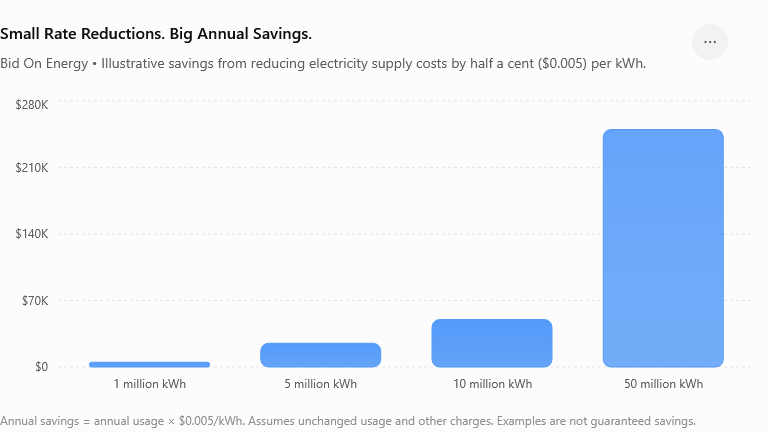
A fraction of a cent may look insignificant on a proposal. Multiply it by a facility’s annual electricity consumption, and the financial impact becomes clear.
For example, a supply-rate reduction of **half a cent per kilowatt-hour $0.005/kWh **would produce the following annual savings if usage and all other charges remained unchanged:
| Annual electricity usage | Illustrative annual savings |
|---|---|
| 1 million kWh | $5,000 |
| 5 million kWh | $25,000 |
| 10 million kWh | $50,000 |
| 50 million kWh | $250,000 |
These examples are calculations, not savings guarantees. They show why large electricity users should make competitive purchasing part of their operating strategy.
Why Compare Multiple Electricity Suppliers?
An electricity supplier’s offer reflects more than how much power a business uses. Pricing can depend on when the facility operates, its location, contract start date, demand patterns, and the risks included in the agreement.
Different suppliers may evaluate the same account differently. One may offer a more attractive price for steady, around-the-clock consumption. Another may be more competitive for a particular contract length or service territory.
Bid On Energy describes an auction-based approach that allows businesses to compare offers from multiple suppliers and evaluate contract terms. Bringing competing offers together helps businesses make a more informed purchasing decision.
The goal is to identify the lowest competitive offer with terms that fit the business, rather than relying on a single renewal proposal.
Understanding Wholesale Commercial Electricity Rates
Businesses often search for “wholesale commercial electricity rates” when looking for better pricing on large accounts. Wholesale electricity prices influence supplier offers, but a commercial supply agreement generally includes additional costs and contractual obligations.
A low energy-only quote may exclude charges included in another supplier’s price. Before choosing an agreement, businesses should compare:
- The electricity supply price and contract duration.
- Whether capacity, transmission, and other supply-related charges are included or passed through.
- Usage requirements and provisions covering increases or decreases in consumption.
- Early termination terms and renewal conditions.
- The effect of planned expansion, new equipment, or additional locations.
Utility delivery charges generally remain separate. A meaningful comparison examines the full scope of each offer, so an attractive headline rate does not obscure additional costs.
How to Get Started With Bid On Energy
Start by providing a recent electricity bill and your current contract expiration date. For a large facility, historical usage information and details about future operational changes can also help suppliers evaluate the account.
Ask Bid On Energy to review your eligibility for custom pricing and compare available suppliers, contract lengths, and supply structures. Supplier availability varies by location, utility territory, and account characteristics. - click here
For data centers and other major electricity users, this review should begin before the current agreement expires, allowing time to evaluate proposals and coordinate the next contract.
Make Suppliers Compete for Your Business
Your business invests heavily in electricity. Give that purchasing decision the attention it deserves.
Whether you operate a data center, manufacturing plant, refrigerated warehouse, hospital, or portfolio of commercial properties, Bid On Energy can help you compare available electricity suppliers and pursue competitive pricing suited to your operation - Click Here
Data centers power servers, cooling systems, networking equipment, and supporting infrastructure around the clock. The table shows annual consumption at different average total facility power loads.
| Average facility power load | Daily electricity usage | Annual electricity usage | Annual savings at $0.005/kWh lower |
|---|---|---|---|
| 1 MW | 24,000 kWh | 8.76 million kWh | $43,800 |
| 5 MW | 120,000 kWh | 43.8 million kWh | $219,000 |
| 10 MW | 240,000 kWh | 87.6 million kWh | $438,000 |
| 25 MW | 600,000 kWh | 219 million kWh | $1,095,000 |
| 50 MW | 1.2 million kWh | 438 million kWh | $2,190,000 |
| 100 MW | 2.4 million kWh | 876 million kWh | $4,380,000 |
| 250 MW | 6 million kWh | 2.19 billion kWh | $10,950,000 |
| 500 MW | 12 million kWh | 4.38 billion kWh | $21,900,000 |
Visit BidOnEnergy.org or email Support@BidOnEnergy.org with a recent utility bill to request a commercial electricity supply comparison.