
October 2026 Commercial Energy Outlook
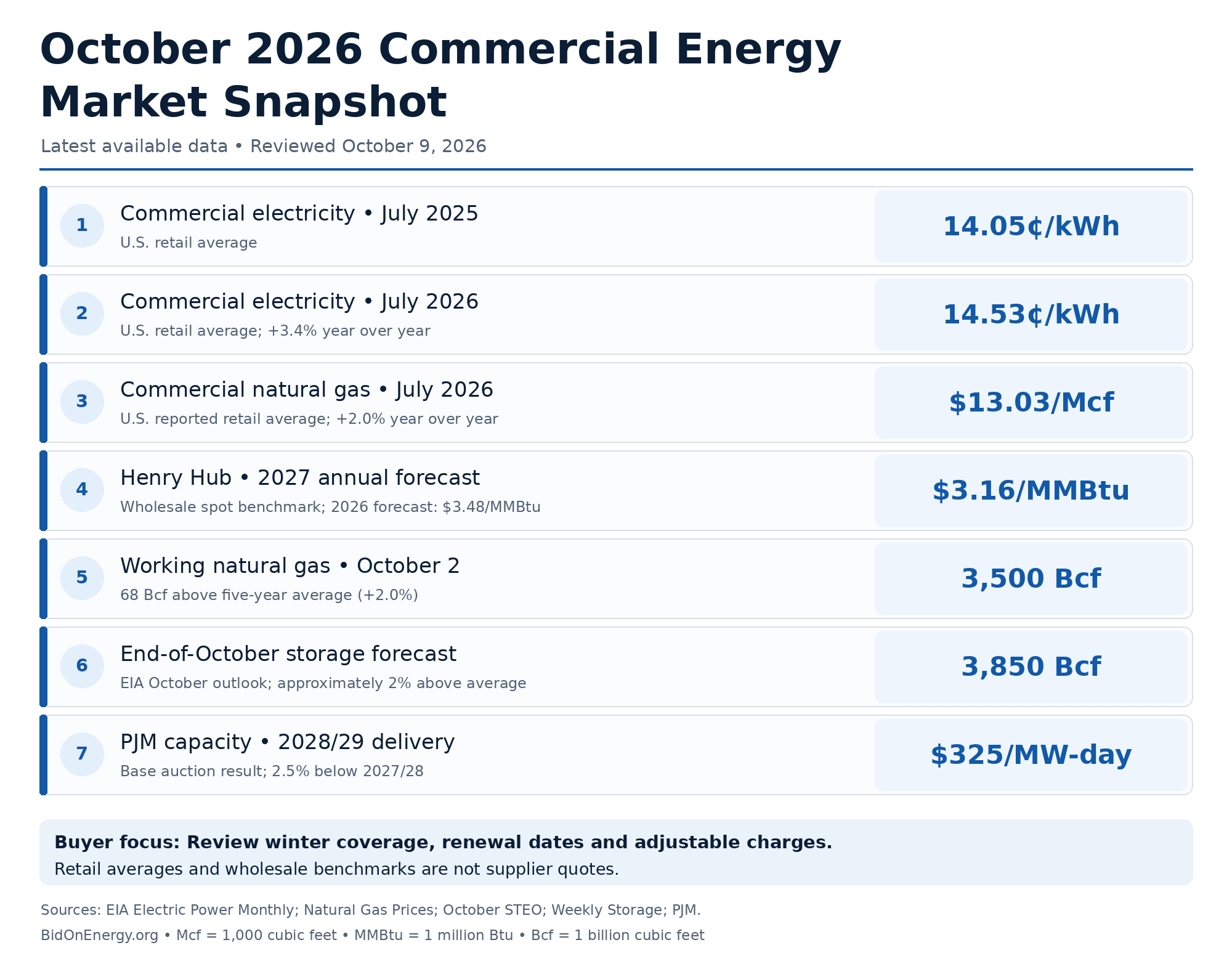
October 2026 Commercial Energy Outlook
Electricity & Natural Gas Market Analysis for U.S. Businesses
Commercial Energy Outlook · October 2026
October is a planning month for businesses preparing for winter energy expenses and 2027 contract renewals. The latest market data present a mixed picture: commercial electricity prices remain above year-earlier levels, while natural gas inventories provide some protection against winter demand. Neither signal guarantees that an individual business will receive a lower renewal offer.
For commercial energy buyers, the priority is to compare available contracts, understand what each rate includes, and match the agreement to the business’s budget and operating needs.

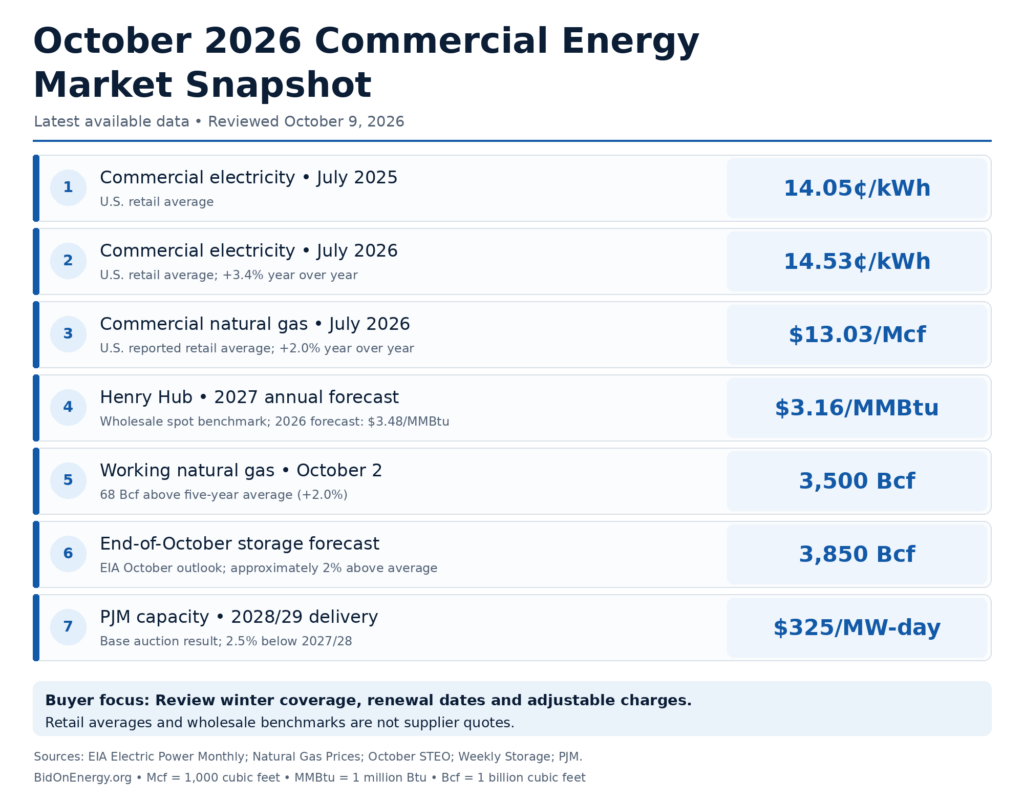
October 2026 Energy Market Snapshot
| Market indicator | Latest information available October 9 |
|---|---|
| U.S. commercial electricity average | 14.53¢/kWh in July 2026 |
| Commercial electricity annual change | +3.4% versus 14.05¢/kWh in July 2025 |
| U.S. commercial natural gas average | $13.03/Mcf in July 2026; about +2.0% year over year |
| Henry Hub annual spot-price forecast | $3.48/MMBtu for 2026; $3.16/MMBtu for 2027 |
| Working natural gas storage | 3,500 Bcf for the week ending October 2 |
| Storage versus five-year average | 68 Bcf above average, approximately 2.0% |
| End-of-October storage forecast | Approximately 3,850 Bcf |
| PJM 2028/29 base auction price | $325/MW-day, down approximately 2.5% from 2027/28 |
| October purchasing focus | Winter exposure, renewal timing and total contract cost |
Sources: EIA commercial electricity data [1], commercial natural gas data [2], October forecast [3], weekly storage report [4], and PJM auction results [5]. Annual percentage changes are calculated from the published values.
These benchmarks measure different things. The electricity figure is a national retail average, not a supplier-only quote. The commercial gas figure is a reported retail price for gas sold to commercial consumers, not Henry Hub or an account-specific supply offer. Mcf means one thousand cubic feet; MMBtu measures heat content. Actual supplier pricing depends on location, usage, start date and contract terms.
Electricity Outlook: Retail Costs Remain Elevated Despite Potential Wholesale Relief
EIA’s latest monthly release reports a July 2026 U.S. commercial electricity average of 14.53¢/kWh, compared with 14.05¢/kWh a year earlier. July is the latest published month in that release; it should not be labeled an October retail rate. [1]
EIA’s October outlook forecasts average wholesale power prices across its 11 tracked hubs at $52/MWh in 2026 and $49/MWh in 2027. That suggests some potential wholesale easing next year, but regional outcomes vary. [6]
For business buyers, wholesale projections are context rather than a price promise. A renewal offer also reflects the customer’s usage pattern and the cost components the supplier agrees to cover. A lower wholesale energy forecast does not ensure a lower total utility bill.
Review electricity proposals on a consistent basis: the same start month, annual usage, product structure and treatment of capacity, transmission and other adjustments. This makes the comparison more useful than simply selecting the smallest advertised cents-per-kWh number.
PJM Capacity: Slightly Lower Forward Price, Still a Major Budget Item
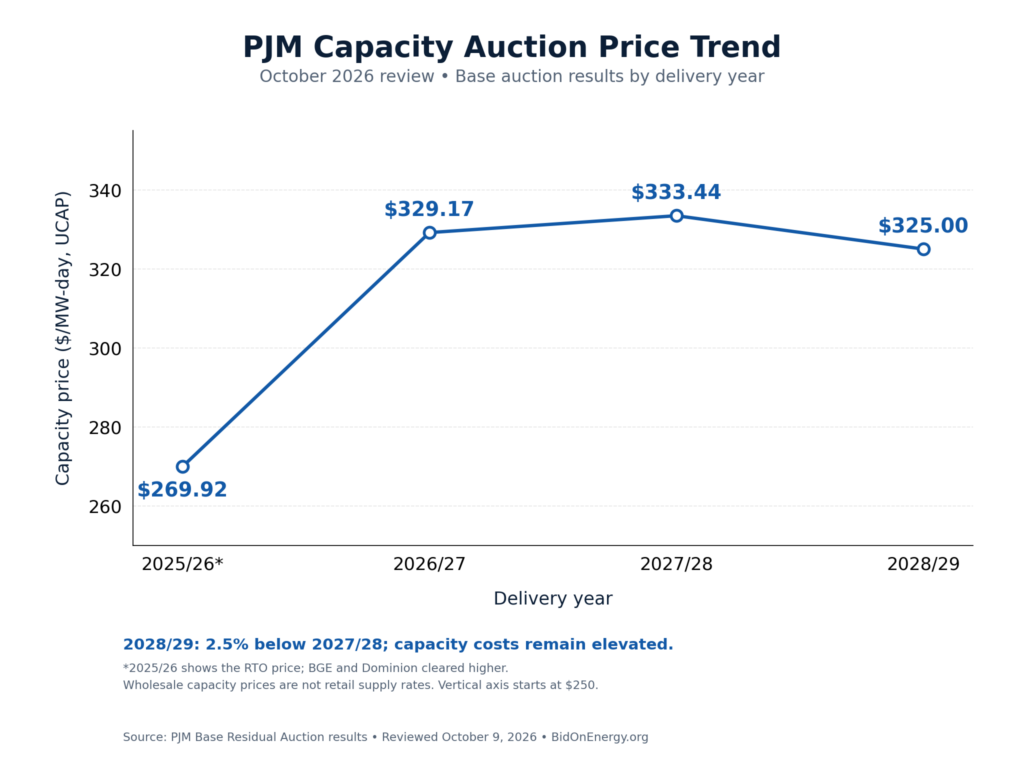
PJM’s 2028/29 Base Residual Auction cleared at $325/MW-day, below the $333.44/MW-day result for 2027/28. The result was announced in July 2026; it is an existing forward-market result being reviewed in this October update, not a new October auction. [5]
| Delivery year | Base auction capacity price |
|---|---|
| 2025/26 | $269.92/MW-day* |
| 2026/27 | $329.17/MW-day |
| 2027/28 | $333.44/MW-day |
| 2028/29 | $325.00/MW-day |
The 2025/26 value is the RTO clearing price; BGE and Dominion cleared higher. These are wholesale capacity prices, not retail electricity supply rates. Sources: PJM [5, 7, 8, 10].

The modest decline offers some relief, but the 2028/29 auction still reported a 6,831 MW shortfall against PJM’s reliability requirement. This describes the auction’s reserve position; it is not a prediction that customers will lose service. [5]
For businesses served within PJM, ask whether capacity is included in the proposed supply rate, separately passed through, or subject to adjustment. Also ask how changes to the account’s capacity obligation could affect charges during the contract.
October 2026 electricity - natural gas graph
Natural Gas Outlook: A Storage Cushion, With Winter Exposure Ahead
The latest EIA commercial natural gas series reports $13.03 per thousand cubic feet in July 2026, compared with $12.77 in July 2025—an increase of approximately 2.0%. This historical retail benchmark should not be presented as an available October supplier rate. [2]
EIA’s October forecast puts the annual Henry Hub spot-price average at $3.48/MMBtu for 2026 and $3.16/MMBtu for 2027. These are full-year forecasts, not today’s spot price or a fixed winter quote. [3]
The October 8 storage release showed 3,500 Bcf in storage for the week ending October 2. Inventories were 68 Bcf above the five-year average, but 130 Bcf below the year-earlier level. [4]
EIA forecasts approximately 3,850 Bcf in storage at the end of October, around 2% above the five-year average. This provides a cushion, though prolonged cold weather could draw stocks down faster than expected. [3]
What This Means for Commercial Natural Gas Buyers
Businesses with substantial heating or process-gas demand should compare winter coverage before their current agreement ends. Ask suppliers to identify the commodity price, regional basis, transportation-related charges and any balancing or usage provisions.
A fixed commodity price may still leave other costs variable. Confirm whether an offer fixes the relevant supply components through the delivery point and how unusual usage affects billing. Compare all proposals in the same unit; do not treat Mcf and MMBtu as interchangeable without the applicable heat-content conversion.
Northeast Businesses Should Review Winter Basis Risk
Henry Hub is only one part of the Northeast’s winter price story. ISO New England explains that cold-weather heating demand can fill regional gas pipelines, leaving less fuel available for power generation. [9]
This creates exposure to regional gas-price differences, often called basis, and can also affect electricity prices. A comfortable national storage balance does not eliminate local constraints.
For a Northeast business, the useful question is: How much of my winter delivered supply cost is actually fixed? Have the supplier identify any regional basis, transportation or market costs that remain adjustable.
Top 7 Things Commercial Energy Buyers Should Consider in October 2026
1. Confirm the renewal date now. Check the supply agreement, notice deadlines and meter cycle. Request future-start options where available so the next contract aligns with the existing expiration.
2. Compare multiple contract lengths. Request 12-, 24-, 36-, 48- and 60-month options where offered. A longer term can improve budget predictability, but the value depends on its price and your plans for the facility.
3. Read the definition of “fixed.” For Fixed All-In electricity, confirm the included components and exceptions. For Fixed with Adjustment, ask exactly what can change, how the change is calculated and whether decreases are passed through too. The signed agreement controls.
4. Compare equivalent supply costs. Match supplier offers against the utility’s applicable supply or default-service charges. Do not compare a supplier-only quote directly with a total-bill average that includes delivery charges.
5. Check winter gas exposure. Identify whether commodity, basis and relevant transportation costs are fixed or variable. Review usage tolerances, balancing charges and any operational obligations.
6. Provide accurate account information. Supply a recent bill, service address, rate class, annual usage and preferred start month. Larger accounts may benefit from interval usage and a review of load factor and capacity obligations.
7. Avoid an unmanaged contract expiration. Get written confirmation of what happens when the agreement ends. Automatic renewal, variable service and return-to-utility arrangements depend on the contract and local rules.
October 2026 Buyer Strategy
The appropriate decision depends on the account’s current price, renewal deadline and tolerance for changing costs.
Contracts ending this winter: Gather current offers and compare the cost of budget certainty with the risks of remaining exposed. Leave enough time for contract review and enrollment.
Contracts ending in 2027: Ask whether suppliers offer forward-start pricing. Compare the available premium or discount across terms before deciding whether to secure coverage early.
Businesses with favorable existing agreements: Check their remaining term and termination provisions before considering a change. A lower headline offer may not justify exit costs.
Businesses considering a long agreement: Include expected relocations, closures, expansions and changes in energy use in the review. Predictability is most valuable when the contract fits how the business will operate.
October 2026 Market Assessment
The following is Bid On Energy’s editorial interpretation of the cited information, not an EIA rating or a guarantee of future pricing.
| Market area | October assessment | Purchasing implication |
|---|---|---|
| Natural gas fundamentals | Storage provides a cushion | Compare winter protection and remaining variable charges |
| Electricity commodity | Mixed; some forecast easing in 2027 | Evaluate local offers rather than relying on a national trend |
| PJM capacity | Elevated despite a modest forward decline | Verify capacity treatment in every proposal |
| Northeast winter exposure | Weather-sensitive | Review regional basis and delivered supply costs |
| Contract timing | Account-specific | Use renewal deadlines and budget needs to guide the decision |
Compare Commercial Electricity & Natural Gas Suppliers
October is a practical time to review winter exposure and upcoming renewals. Comparing offers now gives your business a clearer view of available prices, contract protections and costs that could still change.
Bid On Energy helps businesses compare commercial electricity and natural gas suppliers in eligible deregulated markets. Send a recent utility bill and your current contract’s expiration month and year to begin the review.
Compare available suppliers, several contract lengths and clearly defined product structures before choosing the option that fits your business.
Email: Support@BidOnEnergy.org
Phone: (302) 360-8110
Information reviewed October 9, 2026. Historical observations and forecasts are labeled separately. Actual offers change and depend on utility, location, eligibility, usage, credit, start date and contract provisions. Savings are not guaranteed.