
Fixed All-In vs. Fixed with Adjustment
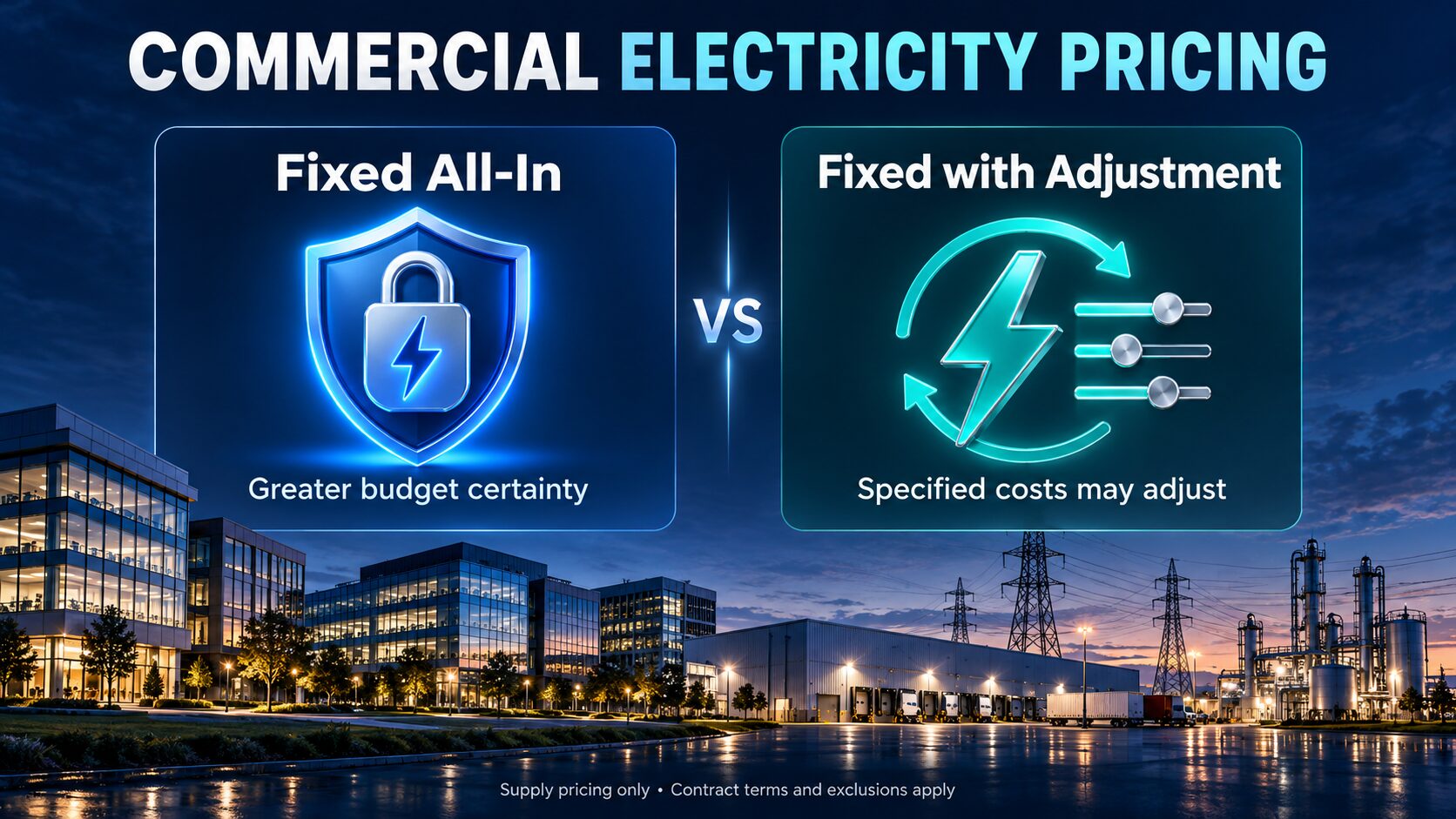
Fixed All-In vs. Fixed with Adjustment
Choosing a commercial electricity supply contract involves more than finding the lowest advertised price per kilowatt-hour (kWh). You also need to understand which costs are locked in, which can change, and who carries the risk.
Commercial Electricity Pricing Explained
Fixed All-In generally provides greater supply-price certainty. Fixed with Adjustment locks in specified components but allows defined costs to change under the contract. Product names vary by supplier and market; the signed agreement determines your actual protection.
Understanding the Two Pricing Options
Fixed All-In combines the supply components specified in the agreement into one fixed price. Depending on the market and contract, these may include energy, capacity, supply-side transmission, ancillary services, line losses, and renewable compliance costs. Review exclusions even when the quote says “all-in.”
Fixed with Adjustment generally includes a fixed energy component and one or more adjustable components. An adjustment might reconcile an estimated capacity allowance with actual costs, reflect a change in your account’s capacity obligation, or update another specifically identified charge. It does not automatically mean the entire supply rate follows the wholesale market.
Supplier examples illustrate why definitions matter: IGS describes capacity pricing with placeholders for unknown years, while Constellation explains a structure that adjusts for changes in capacity obligations. These are different sources of price exposure.
| Feature | Fixed All-In | Fixed with Adjustment |
|---|---|---|
| Supply pricing | Defined supply components bundled into a fixed rate | Defined components fixed; others adjustable |
| Budget predictability | Generally greater, subject to exclusions | Depends on adjustment size and timing |
| Starting quote | May include more protection against cost changes | May be lower, but not necessarily cheaper overall |
| Exposure to cost increases | Supplier bears risk for covered components | Customer bears risk for adjustable components |
| Benefit from falling costs | Covered fixed components generally stay unchanged | Possible if the formula provides downward adjustments |
| Utility delivery charges | Usually separate | Usually separate |
| Main review question | What is excluded from the fixed price? | What can change, when, and by how much? |
An Illustrative Cost Comparison
Assume a business uses 50,000 kWh per month and receives these hypothetical offers:
| Pricing scenario | Effective supply rate | Monthly supply cost |
|---|---|---|
| Fixed All-In | $0.1000/kWh | $5,000 |
| Fixed with Adjustment, before any adjustment | $0.0940/kWh | $4,700 |
| Same adjustment plan with a $0.0040/kWh increase | $0.0980/kWh | $4,900 |
| Same adjustment plan with a $0.0100/kWh increase | $0.1040/kWh | $5,200 |
The adjustment offer starts $300 lower per month. An added $0.0060/kWh, or 0.6 cents, eliminates that initial advantage. A larger increase makes it more expensive for the affected usage.
These are examples, not current market quotes. They exclude utility delivery charges, taxes, and other excluded fees. Actual adjustments may be billed in dollars or based on demand rather than as a simple per-kWh adder.
Top 20 Frequently Asked Questions
1. What does Fixed All-In mean for commercial electricity?
It generally means the supplier bundles the agreed supply components into one fixed rate for the contract term. The purpose is to improve budgeting and transfer covered market-price risk to the supplier. Confirm the included components in writing.
2. Does “all-in” mean my entire electric bill is fixed?
No. It generally describes the supply price, not the total utility bill. Delivery charges, taxes, demand charges, and other excluded items may still apply. Your bill also changes when your electricity usage changes.
3. What does Fixed with Adjustment mean?
It means part of the pricing is fixed while identified costs can be revised under a contract formula or trigger. Ask the supplier to identify every adjustable component and provide a sample calculation before signing.
4. Which charges can be adjusted?
Depending on the agreement, adjustments may involve capacity, supply-side transmission, ancillary services, or specified regulatory costs. Some products adjust only one component. Do not assume every item on this list applies to every offer.
5. Is Fixed with Adjustment the same as a variable-rate plan?
Not necessarily. A defined adjustment may affect only one component while the energy price remains fixed. The practical difference is how much of the price can move and what determines that movement.
6. Why might the adjustment offer have a lower starting rate?
The supplier may be assuming less risk or using an allowance for costs that will be settled later. A lower initial quote may reflect different assumptions rather than a lower total cost over the contract.
7. Can an adjustment reduce my price?
Possibly, if the agreement requires downward adjustments or credits. Ask whether the formula works in both directions and whether it includes floors, caps, or limitations. Do not assume a cost decrease automatically reaches your bill.
8. How often can adjustments occur?
The agreement controls the timing. Adjustments may occur monthly, at a scheduled annual reset, after a relevant market result, or when a specified event occurs. Request the schedule and any notice requirements.
9. What is a true-up?
A true-up reconciles an amount already billed or included in the price with the amount determined under the contract. For example, if an included allowance is $500 and the reconciled amount is $650, the difference is $150. Whether an overpayment produces a credit depends on the agreement.
10. What are capacity charges?
In markets with capacity mechanisms, these costs help support sufficient resources to meet electricity demand. A business’s allocated cost can depend on both market capacity prices and its assigned capacity obligation. Fixing one input does not necessarily fix the others.
11. Can my business’s capacity obligation change?
Yes. Account-specific obligations, sometimes called capacity tags, can change under the applicable market and utility methodology. If your contract passes those changes through, your cost can move even when the energy price remains fixed.
12. Is Fixed with Adjustment the same as capacity pass-through?
Not always. A capacity pass-through structure generally bills the applicable capacity cost separately from fixed components. An adjustment structure may already include a capacity allowance and charge or credit only a defined difference. Confirm the baseline so you can check for double counting.
13. Can a Fixed All-In rate ever change?
Potentially. Agreements can contain change-in-law, regulatory-change, or other exceptions. The scope matters: a narrow provision for newly imposed costs provides different protection from a broad clause permitting many cost changes.
14. What happens if my business uses more or less electricity?
Your total supply cost changes with usage even if the rate stays fixed. Also ask whether the agreement contains usage limits, bandwidth provisions, or material-change terms. Have the supplier explain how expansion, closure, solar installation, or reduced operations would be treated.
15. Which option is better for a business that needs predictable expenses?
Fixed All-In is generally the stronger starting point when supply-price stability is the priority. Evaluate the additional quoted cost against the protection provided, and review exceptions before treating it as a firm budget number.
16. When should a business consider Fixed with Adjustment?
Consider it when the adjustable costs are understandable and the business can absorb changes. Request low, expected, and high cost scenarios. The potential savings should justify the uncertainty and the work required to monitor charges.
17. Does choosing a longer term prevent adjustments?
No. A longer term fixes only what the contract says is fixed. Request a year-by-year explanation of included costs, estimated allowances, and adjustment rights throughout the proposed term.
18. What happens if electricity market prices fall after signing?
The fixed components generally remain at the contracted price. Adjustable components may decrease only as the agreement permits. Ask about any repricing or termination options and their costs before making a commitment.
19. How should I compare competing supplier offers?
Use the same start date, term, usage assumptions, and included components. Ask each supplier for projected total supply costs, an itemized list of exclusions, and adjustment scenarios. Comparing a fully bundled rate with a rate that leaves out material costs can give a misleading result.
20. What should I request before signing?
Request the full agreement and pricing schedule, the list of included and excluded charges, any adjustment formula and baseline, billing examples, notice requirements, and termination and renewal terms. Ask the supplier to show where each explanation appears in the contract.
Choose the Contract Structure That Fits Your Business
Fixed All-In can simplify supply budgeting. Fixed with Adjustment can offer an attractive starting price while leaving your business responsible for specified cost changes.
Compare the expected total cost and the contractual protection not just the opening rate. A clear explanation of what can change is as valuable as the quote itself.
To explore commercial electricity supply options, visit Bid On Energy. Have a recent utility bill and your current contract available to support a meaningful comparison.